- Why Businesses Fail: 10 Lessons to Avoid Costly Business Mistakes
- 1. Most Business Failures Are More Predictable Than They Appear
- 2. Business Fundamentals Still Matter – Regardless of the Industry
- 3. “Let's Just Start Doing Something” Is Not a Strategy
- 4. Ego Can Become One of a Leader's Biggest Business Risks
- 5. Asking for Help Is a Leadership Skill
- 6. Failure Is Only Valuable If You Learn Something
- 7. A Profitable Business Can Still Run Out of Money
- 8. Budgeting Is About Control, Not Restriction
- 9. A Bad Hire Costs Much More Than Salary
- 10. Perseverance and Denial Are Not the Same Thing
- The Advantage of an Outside Perspective
- Learn From Someone Else's Business Mistakes
- Watch Episode 003 of The Lionheart Podcast
- You Don't Have to Build Your Business Alone
Why Businesses Fail: 10 Lessons to Avoid Costly Business Mistakes
Most entrepreneurs spend a great deal of time studying success.
We read about companies that grew quickly, founders who beat the odds, leadership habits that worked, and strategies that produced impressive results.
But there is another way to improve your chances of succeeding in business:
Study the mistakes that repeatedly cause businesses to fail and learn to recognize them before you make them yourself.
That is the premise behind Episode 003 of The Lionheart Podcast, featuring Thom Stimpel and Tom Fleury, co-founders of The Lionheart Team and co-authors of Achieving Success by Avoiding Failure, Become a Lionheart.
After decades of advising entrepreneurs, small businesses, executives, and organizations across many industries, Thom and Tom have seen a remarkable pattern.
Businesses may sell different products. They may operate in completely different industries. Their owners may have very different personalities and backgrounds.
Yet many of them stumble over the same fundamental business problems.
Poor planning. Bad hiring. Weak financial controls. Ego. Failure to adapt. Choosing the wrong customers. Refusing to ask for help.
Their book approaches entrepreneurship from an unusual direction: rather than simply telling business owners what successful people do, it uses real-world cautionary stories to demonstrate what can happen when entrepreneurs ignore the fundamentals.
Here are 10 important business lessons from our conversation.
1. Most Business Failures Are More Predictable Than They Appear
Businesses rarely wake up one morning and suddenly fail.
In many cases, the warning signs were visible long before the final crisis.
- A cash-flow problem was developing.
- An employee was clearly underperforming.
- An owner was spending without a plan.
- A strategic assumption was never tested.
- A customer was causing more problems than revenue justified.
- Management knew something wasn’t working but kept postponing the decision.
One of the strongest ideas from our Episode 003 conversation was that business failure often announces itself quietly.
The danger is not always that the warning signs are invisible.
It is that leaders explain them away.
Business lesson:
When something in your business consistently feels wrong, don’t automatically rationalize it. Investigate it.
Small warning signs are much easier, and usually much less expensive, to address than full-blown business crises.
2. Business Fundamentals Still Matter – Regardless of the Industry
Technology changes.
Markets evolve.
New business models emerge.
But the fundamentals of running a business have not disappeared.
Whether you operate a manufacturing company, professional services firm, local contractor business, technology startup, online business, or creator-led company, you still need to understand things like:
- Customers
- Revenue
- Expenses
- Cash flow
- Staffing
- Marketing
- Operations
- Pricing
- Planning
- Execution
Tom and Thom have worked across very different industries, yet they repeatedly encounter the same underlying problems.
A business owner may believe their industry is unique.
The fundamentals usually aren’t.
Business lesson:
New technology can change how a business operates. It does not eliminate the need to operate the business well.
3. “Let’s Just Start Doing Something” Is Not a Strategy
Entrepreneurs tend to value action and for good reason.
Businesses cannot grow through endless planning with no execution.
But the opposite extreme can be equally dangerous.
Thom summed up one approach they frequently encounter:
Start doing things and hope something good happens.
- Businesses launch advertising campaigns without understanding whether they can handle the new demand.
- They hire employees without clearly defining what those employees need to accomplish.
- They invest in tools without determining whether those tools solve a real problem.
- They add products because competitors have them.
- They spend first and calculate later.
Action without planning can create movement without progress.
Business lesson:
Before making a significant business decision, ask:
What outcome are we trying to create, what resources will it require, and what happens if our assumptions are wrong?
Planning does not eliminate risk.
It helps you take risk intelligently.
4. Ego Can Become One of a Leader’s Biggest Business Risks
Confidence is valuable in entrepreneurship.
Ego can be destructive.
During the episode, Thom and Tom discussed situations where business owners and senior executives ignored employees, advisors, evidence, and even their own organization’s previous experience because they believed they knew better.
One particularly powerful story involved an established company that developed a promising strategic plan with strong support throughout the organization.
- The planning was done.
- The resources were available.
- Employees believed in the direction.
But when implementation began, the CEO took control, dismissed outside support, and repeated the same behaviors employees had warned would derail the initiative.
Eventually, the business was sold.
The acquiring organization later implemented many of the ideas the original company had developed.
The problem wasn’t a lack of intelligence.
It was the inability to recognize that intelligence does not mean knowing everything.
Business lesson:
A strong leader does not need to have every answer.
A strong leader needs enough confidence to recognize when someone else has a better one.
5. Asking for Help Is a Leadership Skill
One of the most dangerous beliefs an entrepreneur can carry is:
“I should be able to figure this out myself.”
No successful business owner is an expert in everything.
- You may understand sales but struggle with financial management.
- You may be an exceptional operator but weak at marketing.
- You may understand your product better than anyone but have little experience hiring employees.
- You may be a visionary who needs someone else to build the systems necessary to turn the vision into a scalable company.
Thom and Tom were clear about this during our conversation:
Successful entrepreneurs surround themselves with people who fill the gaps in their knowledge and experience.
That may include:
- Business advisors
- Accountants
- Attorneys
- Marketing professionals
- Financial professionals
- Industry specialists
- Mentors
- Peer advisory groups
- Other experienced entrepreneurs
And there is an important second lesson:
Ask for help before you desperately need it.
It is much easier to solve a developing business problem than rescue a business that has already run out of options.
Business lesson:
Seeking experienced advice is not an admission that you cannot lead.
Knowing when you need another perspective is part of leadership.
6. Failure Is Only Valuable If You Learn Something
Entrepreneurship has popularized phrases such as:
Fail fast.
Fail often.
Failure is tuition.
There is truth behind those ideas but they can also be misunderstood.
Failure itself does not create value.
Learning from failure creates value.
If you make a mistake, understand why it happened, change your approach, and make a better decision next time, the experience may become valuable tuition.
But if you repeat the same mistake again and again, you are not learning.
You are simply failing repeatedly.
Some highly successful people failed many times before succeeding.
What separated them was not the number of failures.
It was what they did afterward.
Business lesson:
After a significant mistake, don’t just ask:
“What went wrong?”
Also ask:
“What will we do differently because of what we learned?”
If nothing changes, the lesson was wasted.
7. A Profitable Business Can Still Run Out of Money
One of the most important financial discussions in Episode 003 involves the difference between profit and cash flow.
A business can look profitable on paper and still run into serious financial trouble.
Imagine a company delivering $100,000 worth of work.
The revenue exists.
The invoices exist.
The profit may even appear on the financial statements.
But customers take 60 or 90 days to pay.
Meanwhile:
- Payroll is due.
- Rent is due.
- Inventory must be replenished.
- Vendors need to be paid.
- Taxes are coming.
The business can be profitable and still run out of cash.
That is why business owners must understand not only how much they are selling but when money actually enters and leaves the business.
Business lesson:
Revenue tells you what you sold.
Profit tells you whether the economics work.
Cash flow helps determine whether you survive long enough to benefit from either one.
8. Budgeting Is About Control, Not Restriction
Thom Stimpel discussed zero-based budgeting as a way business owners can gain greater financial control.
At its core, the process requires owners to identify what the business actually needs to spend, prioritize those expenses, and make intentional decisions about when additional spending should occur.
Essential operating expenses come first.
Growth investments are prioritized.
As revenue increases, the company can intelligently move down the list.
If conditions deteriorate, management already understands which expenditures can be reduced first.
This reduces emotional decision-making.
A good year no longer automatically means:
“We have money in the bank. What can we buy?”
Instead, the question becomes:
“Where should this capital go to strengthen the business?”
Business lesson:
A budget should not merely record what you intend to spend.
It should help you decide why, when, and whether you should spend it at all.
Financial controls may not be the most exciting part of entrepreneurship.
They are among the most important.
9. A Bad Hire Costs Much More Than Salary
Hiring is another area where Thom and Tom repeatedly see small businesses struggle.
Large companies typically have defined recruiting processes.
Small businesses often don’t.
Owners sometimes hire someone because:
- They liked the person.
- A friend recommended them.
- They interviewed well.
- They seemed enthusiastic.
None of those things necessarily indicate whether someone can actually succeed in the job.
The true cost of a bad hire can include:
- Recruiting expenses
- Management time
- Training
- Lost productivity
- Disruption to other employees
- Missed opportunities
- Customer problems
- Replacement costs
- Potential legal exposure
Then the company must start the hiring process again.
Small businesses should evaluate not only technical ability but characteristics such as accountability, communication, responsibility, judgment, and fit for the role.
Business lesson:
Don’t hire simply because you need a person.
Build a process that helps determine whether you are hiring the right person.
10. Perseverance and Denial Are Not the Same Thing
Entrepreneurs hear a lot about persistence.
- Don’t quit.
- Keep pushing.
- Believe in yourself.
- Persevere.
Those can be valuable principles.
But there is a point where persistence stops being courage and becomes denial.
Successful entrepreneurs remain committed to the goal while remaining flexible about how they achieve it.
They pay attention to evidence.
They learn.
They adjust.
They change direction when circumstances demand it.
They are willing to say:
“That didn’t work. What did we learn, and what should we do next?”
Denial looks different.
The evidence keeps getting worse.
The same problems continue.
Customers aren’t responding.
Cash is disappearing.
Employees are leaving.
The strategy isn’t working.
And the owner keeps saying:
“We just need to push harder.”
Business lesson:
Persistence means refusing to abandon your mission simply because something is difficult.
Denial means refusing to acknowledge that your current approach isn’t working.
Knowing the difference can save a business.
The Advantage of an Outside Perspective
There is another theme running through nearly the entire Episode 003 conversation:
Business owners can become too close to their businesses to see obvious problems.
- You’re surrounded by the company every day.
- You understand its history.
- You remember why certain decisions were made.
- You know all the personalities involved.
- You’ve lived through every crisis.
That experience is valuable.
It can also create blind spots.
Someone outside the situation may look at the same problem and immediately ask:
“Why are you doing it that way?”
And suddenly the answer seems obvious.
That is one reason mentors, advisors, peer groups, and communities of experienced business owners can be so valuable.
They provide perspective without carrying all the emotional baggage surrounding the decision.
Sometimes the smartest thing an entrepreneur can do is allow someone else to see the problem.
Learn From Someone Else’s Business Mistakes
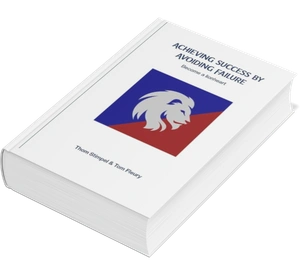
That philosophy is at the center of Thom Stimpel and Tom Fleury’s book:
Achieving Success by Avoiding Failure, Become a Lionheart
Rather than focusing exclusively on successful companies, the book uses real business experiences to show what happens when entrepreneurs ignore important steps, make questionable decisions, fail to plan, or refuse good advice.
- The industries and circumstances differ.
- The lessons are surprisingly universal.
- The goal isn’t to become afraid of making mistakes.
- Mistakes are inevitable.
The goal is to avoid unnecessary mistakes that other entrepreneurs have already made for you.
Why trip over the same stump if someone can point it out before you get there?
📘 Get Achieving Success by Avoiding Failure, Become a Lionheart on Amazon:
https://link.amazon/B06vE9ufE
Thom Stimpel is also the author of The Entrepreneurial Mindset, which explores the mindset and preparation involved in becoming a successful entrepreneur.
📘 Learn more about The Entrepreneurial Mindset:
https://link.amazon/B0dh3KPrV
Watch Episode 003 of The Lionheart Podcast
Hear the full conversation with Tom Fleury and Thom Stimpel as we explore why businesses fail, the warning signs owners often overlook, financial controls, hiring, ego, failure, leadership, and why successful entrepreneurs rarely succeed alone.
🎙️ Watch Episode 003 on YouTube:
https://youtu.be/ccF0vCjYONU
The Lionheart Podcast is also available on Spotify, Apple Podcasts, and most major podcast platforms.
You Don’t Have to Build Your Business Alone
One of the most important conclusions from our conversation has little to do with failure itself.
It has to do with who surrounds you while you build.
Successful entrepreneurs do not need to know everything.
They need access to people who can challenge their thinking, share experience, help identify blind spots, provide specialized expertise, and sometimes tell them something they don’t particularly want to hear.
That philosophy is central to The Lionheart Team.
The Lionheart Den brings entrepreneurs, business owners, leaders, advisors, and experienced professionals together in a private community where members can ask questions, share experiences, learn from one another, and access practical business resources.
Membership also includes access to the Lionheart Business Training Center.
🦁 Join the Lionheart Den:
https://lionheart.thrivecart.com/lionheart-den/
Or learn more about The Lionheart Team and our members:
https://lionheartteam.com/we-are/
Because no entrepreneur should have to build alone.
Lead with integrity. Build with courage. Become a Lionheart.

 Paul R. Gelinas is the Chief Revenue Officer at Vital Payroll Advisors, bringing over two decades of experience in driving revenue growth and fostering client relationships. Throughout his career, Paul has been recognized for his strategic vision and ability to lead high-performing teams across various industries.


 Thompson Stimpel is the Founder & Managing Director of Proactive Business Improvements, LLC – a global business advisory group founded in 2002. As a transformational leader with more than 40 years of multi-product, multi-market, multi-national experience, Thom is acknowledged for his unique ability to convert “strategic concepts” into “operational realities”.